

Views: 126 Author: Site Editor Publish Time: 2026-06-23 Origin: Site


Achieving a high-quality finish without altering the dimensional tolerances of a machined component remains a persistent challenge in modern metal fabrication. Aggressive abrasives risk gouging the base metal quickly. Conversely, overly soft tools fail to remove persistent defects efficiently. To solve this common production bottleneck, operators increasingly turn to the Unitized Wheel. This specialized, non-woven abrasive tool is engineered for unmatched consistency and durability. It perfectly bridges the critical gap between heavy stock removal and final polishing.
By integrating these tools into your process, you achieve a controlled, highly predictable cut rate every single time. This article provides engineers, procurement teams, and shop floor managers a clear, actionable framework. You will learn how to properly evaluate, specify, and implement these wheels into your daily finishing workflows. By understanding their unique construction and application strengths, you can easily elevate your surface preparation results while keeping part geometries perfectly intact.
Definition: Unitized wheels are constructed from compressed layers of non-woven synthetic fibers, abrasive minerals, and resin, offering a uniform finish as they wear.
Core Functions: Ideal for precision tasks; they effectively clean the surface, remove burr, and seamlessly smooth the edge and the angle of workpiece without altering base dimensions.
Key Differentiator: Unlike convolute wheels, unitized wheels are non-directional, allowing them to be mounted and run in either direction.
Selection Logic: Specification depends on a strict balance of density (hardness), abrasive type (Aluminum Oxide vs. Silicon Carbide), and grit size to match the workpiece material and desired finish.
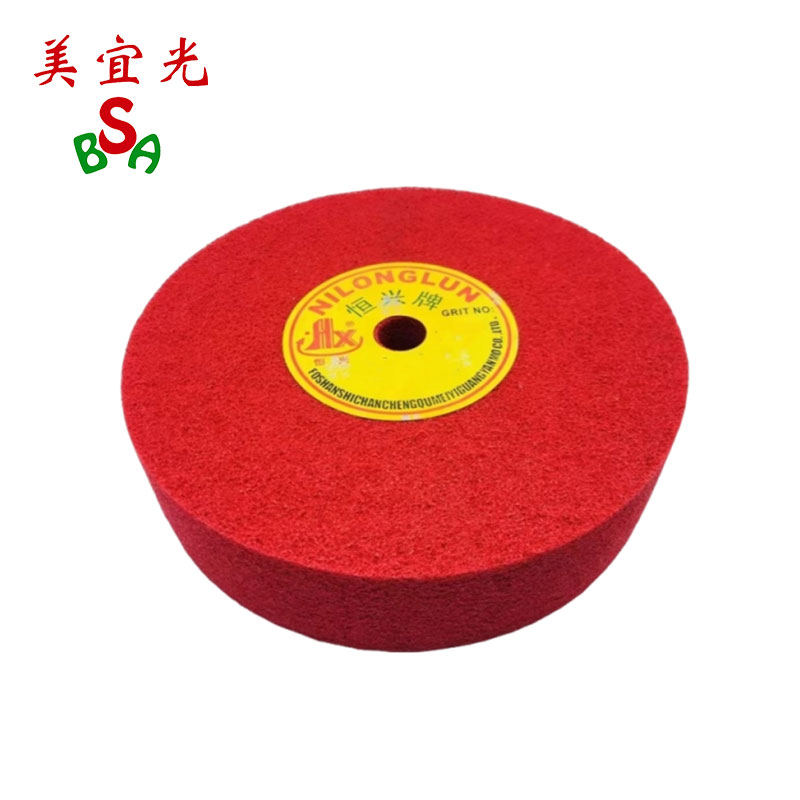
Understanding how these tools perform requires looking closely at their three-part construction. First, they feature a non-woven synthetic nylon web. This open web acts as a highly resilient, spring-like backbone. Next, we integrate premium abrasive grains evenly throughout this entire web structure. Finally, we bond the fibers and grains together using specialized, heat-resistant synthetic resins like polyurethane or phenolic compounds.
The manufacturing process itself guarantees reliable consistency. Manufacturers stack multiple layers of this abrasive-coated web. They compress these layers heavily under high heat. This intensive curing process fuses the distinct layers into a single, unified block. We call this specific curing state "unitized." Manufacturers then die-cut this solid block into individual wheels. This method ensures uniform abrasive distribution from the outer edge straight down to the inner core.
This unique construction drives tremendous business value on the shop floor. As you operate the tool against a workpiece, the synthetic nylon fibers slowly break down. This continuous, controlled wear exposes entirely fresh, sharp abrasive grains. You rarely experience wheel glazing. The tool cuts just as aggressively on day one as it does on day ten. You will reduce manual rework significantly. You also guarantee a highly repeatable finish across long, demanding production runs.
Store wheels in a dry, temperature-controlled environment to prevent resin degradation.
Inspect the wheel edge before every shift to ensure uniform wear patterns.
Dress the wheel lightly if you notice any minor edge distortion after heavy use.
What exactly do these specialized tools do in a real-world fabrication environment? They excel in four primary finishing disciplines, making them incredibly versatile for both automated and manual operations.
First, they deburr precision components safely. Machined threads, laser-cut panels, and intricate stamped parts often harbor microscopic metal flakes. Hard grinding wheels can easily ruin the base geometry during removal. Instead, you need a conformable tool. The non-woven web conforms directly to the part geometry. It allows you to safely remove burr profiles without damaging adjacent critical surfaces.
Second, they handle edge radiusing and blending with incredible precision. Aerospace turbine blades and medical implants require perfectly smooth, safe edges. Sharp corners create dangerous stress risers in these industries. You use this tool to effectively smooth the edge and the angle of workpiece. The sharp transition quickly becomes a uniform, safe radius.
Third, they excel at comprehensive surface preparation. Before painting, welding, or powder coating, you must Clean the surface perfectly to ensure strong adhesion. The open web easily strips away heavy oxidation. It removes stubborn rust and weld discoloration (heat tint) quickly. It clears away light coatings without packing the wheel with debris.
Finally, they produce exceptional final finishes. You can generate decorative #3 or #4 architectural grain finishes effortlessly. They work beautifully on stainless steel handrails, commercial kitchen enclosures, and elevator panels.
Applying excessive pressure during deburring, which causes premature wheel wear.
Using a hard wheel on soft aluminum, leading to deep, uncorrectable scratches.
Skipping surface preparation steps before applying final decorative finishes.
Many operators confuse unitized formats with convolute formats. They share similar base materials but differ drastically in their construction geometry. Choosing the wrong format can cause severe safety issues.
Directionality is the primary risk factor. Convolute wheels feature non-woven material wrapped tightly around a central core. Because of this wrapping, you must run them in one specific direction. If you reverse the rotation, the material can unravel dangerously. In contrast, manufacturers layer and compress the unitized format flat. This makes them entirely non-directional. You can mount them freely. You can run them in either direction safely. This makes them inherently safer for multi-angle handheld tools like die grinders.
Size and tool compatibility also differ significantly. You typically find unitized options in much smaller sizes. They usually range from 1 to 6 inches in diameter. We engineer them specifically for high-speed die grinders and rotary tools. Conversely, convolute wheels are generally much larger. They typically start at 6 inches and go up to 14 inches. You mount convolute wheels primarily on stationary bench grinders.
Finally, consider the density range. The compressed layering process allows for much harder density options. You can utilize a hard unitized option for highly aggressive edge work. Standard convolute wheels generally max out at medium densities.
Feature | Unitized Format | Convolute Format |
|---|---|---|
Directionality | Non-directional (runs safely in either direction) | Directional (must follow the indicated arrow) |
Typical Size | 1" to 6" diameter | 6" to 14" diameter |
Tool Compatibility | Die grinders, rotary tools, angle grinders | Stationary bench grinders, pedestal grinders |
Density Range | Soft to extremely hard (1-9 scale) | Soft to medium-hard |
Selecting the correct tool requires a logical, step-by-step framework. You must carefully balance three primary variables to achieve the desired finish on your specific workpiece material.
Density dictates the physical hardness and conformability of the tool.
Soft (2-3): These offer high flexibility. Use them for light blending on complex, contoured surfaces.
Medium (4-6): This is your versatile workhorse. It handles general-purpose deburring and moderate edge radiusing efficiently.
Hard (7-9): These provide maximum edge retention. Choose them for heavy deburring and aggressive action on very hard alloys.
You typically choose between two premium grain structures.
Aluminum Oxide (A): This is a highly durable, blocky grain. It fractures slowly. It works best for general metalworking, carbon steel blending, and generating matte finishes.
Silicon Carbide (S): This grain is much sharper and cuts faster. It fractures easily to reveal new sharp edges. It is ideal for non-ferrous metals like titanium, brass, and aluminum. It also achieves brighter, finer finishes.
Grit size directly impacts the final Ra (Roughness Average) value of your surface.
Coarse (C): Best for rapid stock removal and heavy scale cleaning.
Medium (M): Ideal for general blending and removing moderate machine tool marks.
Fine (F): Perfect for pre-polishing surface refinement.
Very Fine (VF): Used extensively for final decorative finishes and ultra-light cleaning.
How do you shortlist the right combination? Match the base material hardness and defect size against the tool's density and grade. For example, removing a heavy burr from a titanium aerospace part requires a Hard Density, Silicon Carbide, Medium Grit tool. Blending a light scratch on soft aluminum requires a Soft Density, Silicon Carbide, Very Fine tool.
Application Goal | Recommended Density | Recommended Abrasive | Recommended Grade |
|---|---|---|---|
Heavy burr removal on steel | Hard (7-9) | Aluminum Oxide (A) | Coarse / Medium |
Light blending on aluminum | Soft (2-3) | Silicon Carbide (S) | Fine / Very Fine |
Edge radiusing on titanium | Hard (7-9) | Silicon Carbide (S) | Medium |
General cleaning on stainless | Medium (4-6) | Aluminum Oxide (A) | Medium / Fine |
Even the best abrasive specification fails if your operators implement it poorly. You must manage shop floor safety, tool speeds, and mounting hardware carefully to ensure success.
Maximum Operating Speed (MOS) is your most critical safety requirement. You must strictly match the wheel’s printed MOS to the tool’s actual RPM. Running any abrasive above its rated MOS is exceptionally dangerous. It risks catastrophic centrifugal failure and severe operator injury. Always check the printed rating on the tool face before mounting it to a grinder.
Heat generation poses another practical hurdle. If you apply too much physical pressure, friction heat builds up rapidly. If you run the tool at suboptimal speeds, the synthetic resin begins to melt. This transfers black resin directly onto your workpiece. Industry professionals call this specific defect "smearing." You can easily mitigate this risk. Let the tool do the work for you. Reduce your physical downward pressure. Adjust your tool RPM to sit within the optimal cutting range.
Finally, correct hardware and mounting matter immensely. You must use specialized mounting hardware for non-woven tools. Proper mandrels and exact-fit flanges ensure absolute concentricity. They reduce lateral vibration during operation significantly. Less vibration means less operator fatigue, safer handling, and a noticeably smoother surface finish.
To summarize, this specialized non-woven abrasive is a true precision instrument. We designed it specifically for highly predictable, damage-free metal finishing. It gives you absolute control over your surface outcomes, ensuring you hit tight tolerances every time. You can aggressively clean surfaces or delicately blend edges without ruining expensive base materials.
When finalizing your procurement decision, remember that evaluation always requires physical testing. You must test for the optimal balance on actual scrap parts first. Look closely at the cut rate. Evaluate the final finish quality against your requirements. Measure the overall operational life to gauge efficiency.
Take action today to improve your finishing workflow. Consult directly with an experienced abrasives specialist to audit your current process. Download a comprehensive technical data sheet to guide your next steps. Better yet, request a physical sample matrix for an immediate shop-floor trial to see the results firsthand.
A: Yes, but selecting an open-web, softer density wheel with Silicon Carbide abrasive is highly recommended. Applying a light aerosol lubricant or grease can also prevent soft material packing (loading) deep within the nylon web.
A: They are perfectly compatible with standard die grinders, inline sanders, and bench grinders. Ensure the tool's RPM does not exceed the wheel's stated Maximum Operating Speed (MOS) and always use the correct mounting mandrel.
A: Lifespan depends entirely on application pressure, edge sharpness of the workpiece, and chosen wheel density. Because the abrasive is distributed throughout the entire web, they generally outlast traditional coated abrasives like flap wheels in severe edge-deburring applications.


