

Views: 156 Author: Site Editor Publish Time: 2026-06-16 Origin: Site


The metal finishing industry is rapidly moving away from unpredictable, labor-intensive processes toward automation, strict compliance, and precision. You see this shift on modern shop floors every day, where tight tolerances dictate ultimate success. Traditional abrasives often struggle under these strict requirements, leading to costly rework, part geometry variations, and severe operator fatigue. Legacy grinding wheels frequently gouge expensive materials, while wire brushes create hazardous working conditions. It is no longer viable to rely on legacy methods when margins are this thin.
As facilities upgrade to Industry 4.0 standards and face skilled labor shortages, the Unitized Wheel has emerged as the go-to solution for deburring, blending, and finishing. This guide breaks down the structural engineering behind these advanced abrasives. We explore how to accurately evaluate them for your specific shop environment. You will also learn the direct financial impact they deliver to your finishing line.
Predictable Finishes: Unitized wheels deliver a stable and uniform surface profile (mechanical tooth), drastically reducing paint and plating rework.
Operational ROI: Multi-directional usability and self-sharpening grains drive high work efficiency and lower long-term consumable costs.
Risk Mitigation: Replacing traditional wire brushes or hard grinding wheels with unitized webs lowers heat-induced "smearing" and improves operator safety (less vibration and no flying wire hazards).
Selection Criteria: Proper specification requires balancing density (soft vs. hard), mineral friability (AO vs. SiC vs. Ceramic), and resin bonds to match exact aerospace, medical, or industrial tolerances.
Shop managers face incredibly tight geometric tolerances today. Aerospace and medical components routinely demand sub-Ra16 smoothness levels. Concurrently, manufacturing confronts a shrinking pool of veteran finishers. This loss of tribal knowledge forces operations to rely on tools requiring minimal manual feel. If you rely on rigid grinding wheels or manual wire brushes, you introduce heavy variability into your production line.
Legacy tools carry massive hidden costs that drain daily profitability. These hidden costs manifest across three primary areas:
Overcutting & Part Rejection: Standard bonded grinding wheels feature aggressive stock removal properties. They easily gouge base metals if the operator applies slightly too much pressure. This aggression alters delicate thread geometries or destroys tight corner radiuses. When parts fail quality inspection due to overcutting, the resulting rework destroys profitability.
The "Smearing" Issue: Friction generates intense localized heat during surface finishing. This friction-induced heat causes traditional resin binders inside legacy tools to melt. The molten resin subsequently deposits onto the metal surface as an adhesive smear. You must then introduce a secondary, labor-intensive clean-up step using chemical solvents to remove these blemishes.
Safety & Ergonomics: Manual wire brushes present well-documented projectile hazards. Metal bristles frequently break off at high RPMs, requiring operators to wear heavy, restrictive protective gear. Furthermore, rigid grinding discs transfer high-frequency vibration directly into the operator's hands. Sustained vibration reduces daily output and drastically elevates the risk of repetitive strain injuries.
Understanding the value of these modern abrasives requires looking at their structural engineering. A unitized wheel is manufactured through a highly controlled compression process. Engineers take multiple layers of non-woven nylon web impregnated with abrasive grains and liquid resin. They compress these layers tightly and cure them inside industrial ovens at high temperatures. This curing process creates a dense, solid, three-dimensional block. Manufacturers then stamp this block into precise circular profiles.
Engineers often evaluate finishing tools by comparing unitized construction against traditional convoluted construction. The table below outlines the critical differences.
Evaluation Criteria | Convoluted Wheels | Unitized Wheels |
|---|---|---|
Construction Method | Abrasive web wrapped around a rigid central core | Multiple flat layers of web compressed and heat-cured |
Directionality | Single-direction operation only | Multi-directional usability |
Conformability | Moderate; stays rigid over large contact areas | Exceptionally high; readily adapts to varied geometries |
Ideal Applications | Broad surface blending, flat material preparation | Intricate micro-parts, tight inner radiuses, edge breaking |
The open, 3D non-woven structure provides a unique advantage for finishing operations. As the nylon matrix slowly wears away during use, it continuously exposes fresh, sharp abrasive grains. This mechanism creates a highly consistent mechanical tooth across the workpiece. A mechanical tooth provides the precise surface roughness required for optimal paint and coating adhesion. Because the cutting action remains consistent from the first cut to the tool's end of life, you achieve a Stable and uniform finish. You successfully blend surface imperfections without ever altering the base metal's dimensional integrity.
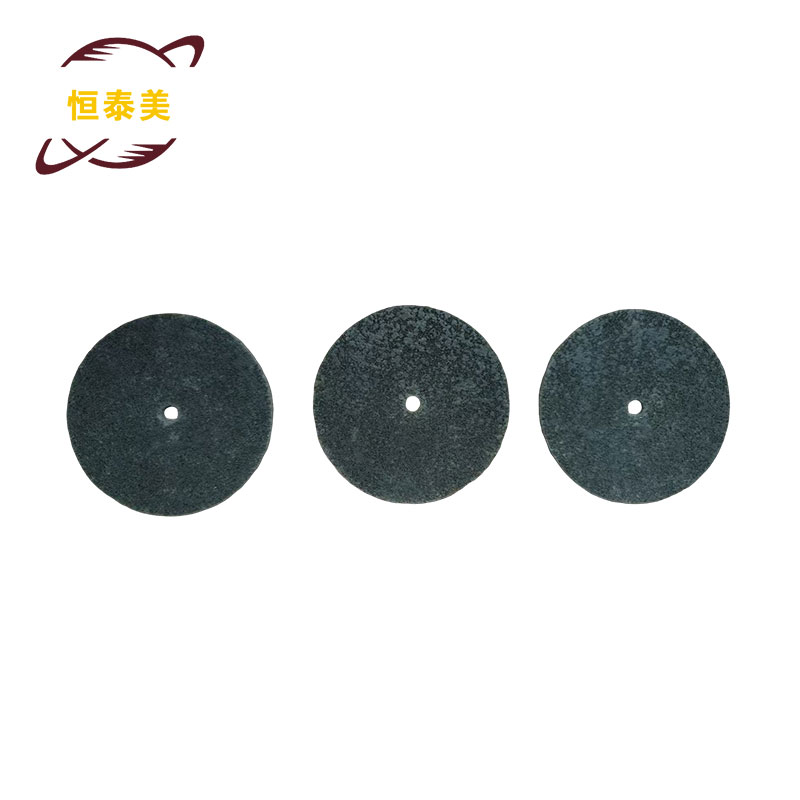
Upgrading to advanced compressed web technology streamlines production lines and directly impacts the bottom line. These tools seamlessly combine deburring and surface blending into a single operational step. By eliminating secondary processing, you shorten cycle times considerably. This operational consolidation drives High work efficiency and allows shop managers to push more volume through the same workstations.
Modern non-woven wheels utilize advanced self-sharpening technology. Manufacturers incorporate ceramic alumina or specialized zirconia grains into the web. These specific minerals feature exceptionally high friability. Friability describes how an abrasive micro-fractures under physical stress. Instead of dulling and rounding over like standard aluminum oxide, highly friable grains snap cleanly. They constantly expose new, razor-sharp edges to the workpiece. Operators achieve much faster cut rates without resorting to aggressive downward pressure.
Beyond cutting speed, these wheels deliver significant ergonomic advantages for shop safety:
Shock Absorption: The resilient nylon matrix acts as a physical buffer. It drastically reduces wheel bounce and chatter against uneven surfaces.
Acoustic Dampening: Compressed web materials run noticeably quieter than solid vitrified stones or steel brushes, improving the ambient shop environment.
Thermal Management: The porous nature of the non-woven web allows air to flow through the tool. This airflow results in significantly cooler cutting temperatures.
Cooler cutting specifically protects heat-sensitive alloys. Materials like titanium, medical-grade stainless steel, and high-nickel alloys remain intact. You eliminate heat discoloration and preserve the metallurgical properties of the substrate.
Procurement and engineering teams need a clear decision matrix. You cannot use a one-size-fits-all approach for aerospace and general fabrication. Selecting the optimal configuration requires balancing three critical variables: density, mineral type, and resin bond.
Density Ratings (The 2 to 9 Scale)
Density determines the tool's physical hardness and conformability.
Soft (2-4): These offer high conformability. They require very light pressure from the operator. Soft densities excel at delicate polishing tasks. They produce a brilliant finish on stainless steel without changing part geometry.
Hard (7-9): These provide high edge durability and an aggressive cut. Hard densities resist tearing when pushed against sharp corners. They represent the best choice for heavy edge breaking, pipe thread deburring, and robust metal fabrication.
Abrasive Grain Selection
Different metals demand different microscopic cutting mechanics.
Silicon Carbide (SiC): This mineral provides a sharper, faster initial cut. It dominates applications involving non-ferrous metals like aluminum and brass. SiC is universally preferred for final cosmetic finishes.
Aluminum Oxide (AO) & Ceramics: These grains are significantly tougher and exhibit lower friability. Manufacturers build them for high-heat, high-stress applications. They aggressively attack carbon steel and exotic superalloys.
Resin Bonds
The chemical binder holds everything together. Look specifically for "clean bond" or specialized high-temp resin technologies. If smearing has historically halted your production line, upgrading the resin chemistry solves the problem.
Application Goal | Metal Type | Recommended Specification Chart |
|---|---|---|
Cosmetic Polish & Fine Blending | Aluminum / Brass | 2-4 Density / Silicon Carbide (SiC) |
Deburring & Bright Finishing | Stainless Steel | 6-7 Density / Aluminum Oxide (AO) |
Heavy Edge Breaking | Carbon Steel / Titanium | 8-9 Density / Ceramic Alumina |
Procurement extends far beyond the physical product. You must evaluate vendors based on their supply chain resilience and depth of technical support. Today's supply chains face constant volatility, so you need a partner capable of reliable delivery.
The regulatory landscape for metal finishing grows stricter every year. Regulators actively push the industry from Best Practical Technology (BPT) toward Best Available Technology (BAT). A reputable metal polishing material manufacturer actively formulates low-VOC, highly durable wheels. These engineered products dramatically reduce overall abrasive waste heading to landfills. Furthermore, forward-thinking manufacturers align their chemical formulations with emerging environmental regulations, such as impending PFAS restrictions. You secure uninterrupted production by partnering with compliant suppliers.
Leading suppliers also aggressively adopt Industry 4.0 methodologies. They provide detailed predictive wear data based on laboratory testing. Some even offer virtual process simulations. These digital tools ensure the selected abrasives perfectly match your specific robotic or CNC finishing cells. Engineers can program tool paths with confidence, knowing exactly how the tool will behave under specific loads.
Non-woven compressed abrasives represent a critical operational upgrade. They secure predictable outcomes in bottom-of-funnel manufacturing processes where precision, safety, and cycle times dictate profitability. While the initial unit price might appear higher than legacy wire brushes or solid stones, the return is undeniable. The complete elimination of costly rework, coupled with extended wheel life, easily justifies the initial investment.
Engineers should immediately audit their current multi-step finishing processes. Identify areas where operators currently use two or three distinct tools to achieve a final blend. Request sample wheels from your manufacturer spanning a soft profile and a hard profile. Run baseline tests on your most frequently rejected parts, monitor the cycle time reduction, and inspect the final surface finish under magnification.
A: No. Unitized wheels are designed specifically for deburring, blending, and finishing. Heavy stock removal or deep weld leveling should still be performed with bonded grinding wheels or flap discs before utilizing a unitized wheel for the final blend.
A: Yes. Running a unitized wheel too fast can generate excessive heat and cause premature breakdown or smearing, while running it too slow reduces the cutting efficiency. Always match the RPM to the manufacturer's specific density and diameter recommendations.
A: Exceptionally well. Because they are highly consistent and multi-directional, unitized wheels are ideal for CNC and robotic applications. Their predictable wear rates allow programmers to set reliable tool-path compensations.


