

Views: 174 Author: Site Editor Publish Time: 2026-06-12 Origin: Site


In precision Metal surface treatment, the final finishing stages carry the highest risk of part rejection. Choosing the wrong abrasive tool can lead to severe over-cutting. It may alter the geometry of a highly critical machined part. It might also cause heat-induced discoloration, commonly known as bluing. These errors destroy expensive workpieces late in the production cycle. A single mistake wipes out hours of labor. While traditional grinding wheels handle heavy stock removal easily, they often prove far too aggressive for delicate operations. Engineers face a critical decision for precision blending, deburring, and final finishing. They usually narrow their choices down to two specialized abrasive tools. Operators must choose between the traditional flap wheel and the compressed unitized wheel.
This guide evaluates both tools comprehensively. We compare material removal rates, finish quality, heat management, and strict tolerance retention. You will learn how to configure the exact abrasive needed for your specific workflow. We aim to help you reduce scrap, lower operator fatigue, and improve overall surface consistency.
Flap wheels excel at medium-to-light stock removal and generating specific linear/brushed scratch patterns, but require strict operator control to avoid altering workpiece dimensions.
Unitized wheels (compressed non-woven nylon) prioritize tolerance retention, offering a highly forgiving, smear-resistant action perfect for precision deburring and polishing without gouging.
The choice hinges on the required outcome: select flap wheels for aggressive blending and grain matching; select unitized wheels for strict geometry preservation and final-stage surface refinement.
Understanding the physical build of an abrasive tool remains absolutely essential. The internal construction dictates how the tool behaves against hard metal. We must compare traditional coated abrasives against modern compressed non-woven webs.
Manufacturers construct standard flap wheels using multiple radial flaps of abrasive cloth. They arrange these overlapping flaps securely around a central steel or resin hub. This specific design operates via a highly unique wiping action. As the wheel spins rapidly, the leading edge of each individual flap strikes the workpiece. The embedded abrasive grain cuts directly into the metal substrate. Over time, the cotton or polyester cloth flaps wear down naturally. This continuous wearing process exposes fresh, sharp abrasive grain hidden underneath.
Consequently, the tool maintains a consistent cut rate throughout its entire operational lifespan. It provides a relatively aggressive grinding action compared to non-woven materials. The flexible nature of the flaps allows them to conform slightly to mild curves. However, they still rely on a fairly rigid backing material. This underlying rigidity translates directly into higher cutting pressure at the point of contact. Operators use them primarily when they need reliable, sustained material removal.
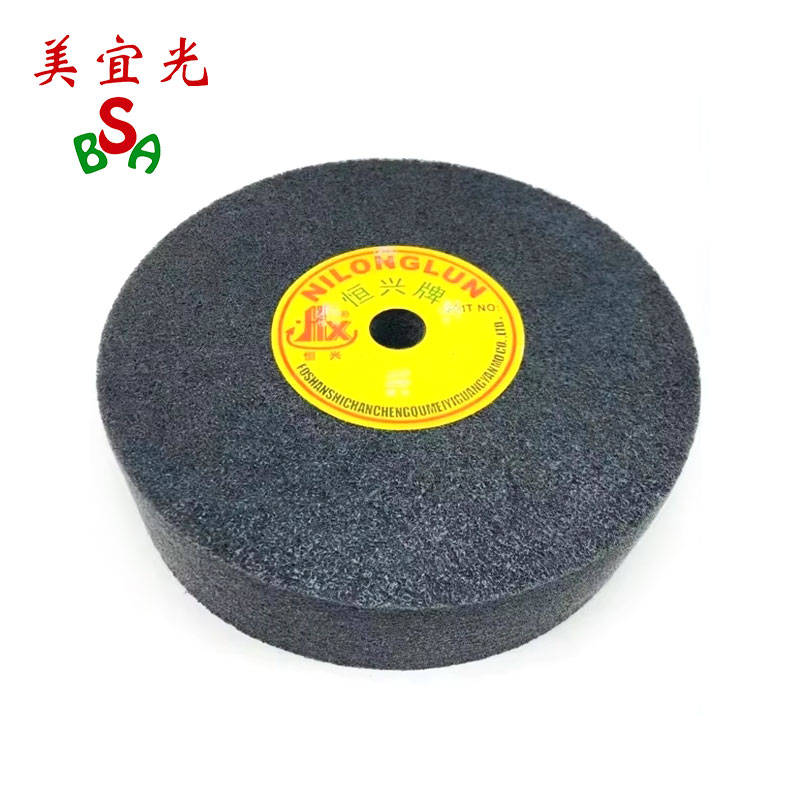
The Unitized Wheel utilizes a completely different and highly advanced manufacturing concept. Manufacturers begin by compressing multiple layers of non-woven nylon web together. They impregnate this porous web evenly using premium abrasive grains and strong synthetic resin. They bake the heavily compressed material carefully into a dense, solid block. Finally, they die-cut or machine the block into individual wheel shapes. This non-woven design operates via a forgiving, cushioned cutting action.
It creates a dense, three-dimensional abrasive matrix. The cutting grain is distributed uniformly throughout the entire solid structure. You get a continuous, highly uniform finish from the first cut to the last. As the nylon web slowly wears away during friction, new abrasive grain emerges seamlessly. The synthetic resin melts slightly under the heat of friction. This controlled melting action smears the abrasive smoothly across the metal surface. It delivers a highly refined polish rather than a deep, aggressive gouge.
A successful finishing operation always balances multiple competing variables. You must evaluate material removal, finish quality, heat generation, and critical dimensional tolerance. We will compare both abrasive tools rigorously across these four core dimensions.
Flap wheels provide significantly higher and faster cut rates. They excel at quickly removing minor welds, deep gouges, or tough mill scale. The rigid cloth backing allows operators to apply substantially more downward pressure. You can dig into the metal aggressively to reshape the surface profile. Unitized wheels remain minimally invasive by their very design. They completely lack the aggressive bite needed for heavy stock removal tasks. You should only deploy them when bulk material removal is already one hundred percent complete. They refine and polish the existing surface instead of actively shaping it.
Each tool leaves a highly unique visual signature on the workpiece. Flap wheels leave a distinct, highly visible inline or brushed finish. The linear action of the individual spinning flaps creates parallel scratch patterns. Many industries desire this specific architectural finish. Unitized wheels, conversely, provide a highly refined, perfectly smooth finish. They blend tiny surface imperfections effortlessly. They create a highly consistent, non-directional surface texture. Often, they completely eliminate the need for secondary polishing steps. You can move directly to powder coating or chemical plating.
Heat remains a major enemy in precision metalwork. Severe overheating permanently weakens complex alloys. It causes ugly thermal bluing on heat-sensitive materials like stainless steel, aerospace aluminum, and titanium. Unitized wheels are exceptionally porous by nature. Their open-web structure allows ambient air to flow freely through the wheel. They run exceptionally cool even under sustained operation. They dissipate generated heat naturally during the finishing process. Flap wheels generate far more friction due to their closed structure. The dense arrangement of cloth flaps traps heat against the metal. Operators require highly careful pressure management to avoid catastrophic thermal damage.
Modern engineers demand incredibly strict dimensional accuracy. Unitized wheels are exceptionally user-friendly and highly forgiving. They conform gently to the microscopic contours of the workpiece. They remove microscopic burrs effectively without altering critical engineered geometries. They will never accidentally flatten a perfectly round, precision-machined edge. Flap wheels pose a much higher risk of accidental flat-spotting. They can gouge curved surfaces quite easily. If an inexperienced operator applies excessive downward pressure, the rigid flaps will distort the part geometry instantly.
Flap wheels continue to dominate specific heavy-duty fabrication tasks. They strike a perfect balance between moderate grinding and initial blending. You should specify them exclusively for operations demanding moderate shaping power.
We strongly recommend flap wheels for the following shop-floor tasks:
Matching factory finishes: They perfectly recreate an existing #3 or #4 brushed finish on large stainless steel panels.
Cleaning pipe interiors: They clean inner diameters (ID) of pipes and tubes highly effectively. Use them where moderate internal rust or scale is present.
Weld blending: They blend small TIG welds smoothly prior to entering the final polishing stages.
Surface leveling: They quickly flatten uneven surfaces on rigid structural steel and iron components.
You must consider the potential operational drawbacks carefully. Flap wheels are highly susceptible to edge-fraying. If you use them aggressively against sharp, jagged burrs, the cloth flaps will tear apart. The tool lifespan drops significantly, costing you more in replacements. They can easily distort tight-tolerance features. Soft metals like brass, copper, and cast aluminum are particularly vulnerable to over-grinding. Overusing a standard flap wheel will permanently ruin the dimensional accuracy of soft alloy parts.
Precision manufacturing requires incredibly delicate touch-ups. A Unitized Wheel steps in exactly when geometry preservation remains mandatory. It acts as the ultimate safeguard against expensive part rejection.
We deploy compressed non-woven wheels heavily in highly critical environments:
Precision radiusing: They excel perfectly at edge radiusing and breaking sharp micro-burrs on machined aerospace or sensitive medical parts.
Defect blending: They seamlessly blend fine machine tool marks. They achieve this flawless blend without creating a new directional scratch pattern.
Coating preparation: They handle pre-paint or pre-plating surface prep flawlessly. They guarantee a uniform, pristine surface for optimal chemical adhesion.
Polishing support: They bridge the difficult gap between aggressive sanding and final compound buffing stages.
These advanced tools demand highly correct application parameters. They typically carry a higher upfront consumable cost compared to standard flap wheels. Budget-conscious buyers might hesitate initially at the premium price tag. Furthermore, they will quickly glaze or load up completely if applied incorrectly. Do not use them on heavy, oily, or highly jagged weld spatter. This represents a severe misapplication of the delicate tool. The soft nylon web will snag rapidly, melt under high friction, and fail prematurely.
We must translate abrasive theory into practical shop-floor reality. The following showdown highlights exactly how each abrasive performs across four highly common metalworking challenges.
Application Type | Recommended Tool | Primary Operational Benefit | Risk of Wrong Choice |
|---|---|---|---|
Precision Deburring | Unitized Wheel | Conforms safely to delicate edges | Gouging the base material severely |
Inline Grain Matching | Flap Wheel | Mimics factory-brushed finish perfectly | Creating unwanted, messy 3D smears |
Heat-Sensitive Alloy Prep | Unitized Wheel | Dissipates heat naturally during use | Thermal damage and ugly bluing |
Budget-Constrained Blending | Flap Wheel | Faster overall stock removal | High secondary finishing labor costs |
Winner: Unitized Wheel. Machined components very often feature microscopic burrs along sharp, freshly cut edges. Removing these tiny burrs requires extreme care and a steady hand. The non-woven wheel conforms incredibly safely to these fine edges. It removes the burr completely without unintentionally chamfering the base material beneath it. A flap wheel would highly likely over-cut the delicate edge. This aggressive over-cutting ruins the strict dimensional tolerance required by aerospace standards.
Winner: Flap Wheel. Commercial stainless steel appliances and architectural building panels demand a very specific visual aesthetic. The linear cutting action of the individual flaps perfectly mimics original factory-brushed finishes on flat sheet stock. The operator can lay down a highly uniform, perfectly straight scratch pattern. Compressed non-woven abrasives leave a smeared, multi-directional finish instead. They completely fail to replicate a linear, industrial grain.
Winner: Unitized Wheel. Titanium alloys and thin-gauge aerospace aluminum warp very easily under high grinding temperatures. They also suffer from severe thermal bluing, which ruins their structural integrity. The open-web, resin-bonded internal structure of a non-woven wheel dissipates heat highly naturally. It strongly prevents the rapid glazing and thermal damage commonly seen under coated abrasives. Operators enjoy a much wider, safer margin of error during extensive prep work.
Winner: Flap Wheel. Standard structural metal fabrication does not always require strict aerospace-level precision. Lower upfront unit cost makes the coated flap design highly attractive for bulk buyers. Faster stock removal basically means workers finish rough parts much quicker. It proves far more economical for standard, non-critical fabrication tasks where visual perfection matters slightly less.
You must evaluate your daily finishing goals highly carefully. Do not treat these specific abrasive tools as easily interchangeable items. They serve completely distinct stages of the modern fabrication process. Default to a flap wheel when your primary operational goal involves actively shaping metal. It remains the absolute best choice for aggressively applying a brushed, linear grain. Pivot quickly to a unitized wheel when your primary goal involves protecting intricate part geometry. It delivers a high-end, smear-free finish utterly flawlessly.
To improve your overall shop floor efficiency, audit your current daily scrap rates. Identify hidden bottlenecks in your secondary-process finishing times. Analyze exactly how many parts fail quality control due to accidental operator gouging. If rejection rates remain stubbornly high, upgrade your critical finishing stations immediately. Implement premium compressed non-woven wheels for all final-stage prep work. Train your operators extensively on proper pressure management techniques. Match the exact right abrasive to the exact task, and you will quickly elevate your overall manufacturing quality.
A: No. They are designed exclusively for gentle blending and final finishing. They are never meant for heavy stock removal. They completely lack the aggressive bite needed to level solid weld beads. Using them on heavy, sharp spatter will instantly destroy the fragile nylon web. Always use a rigid grinding wheel or a high-density flap disc first to flatten the weld.
A: Density selection depends entirely on the target workpiece shape. Lower densities are softer and highly conformable. They work perfectly for curved surfaces and highly complex contours. Higher densities are much harder and more rigid. They perform significantly better for aggressive edge deburring tasks. They also offer much higher durability against tearing on sharp burrs.
A: Yes, absolutely. Unitized wheels generally require much lower operating speeds. Excessive rotary speed melts the internal synthetic resin rapidly. This melting causes it to smear aggressively across the metal surface. It also shortens the tool life drastically. Always match the tool's maximum RPM rating highly carefully to your specific die grinder or finishing tool specifications.


