

Views: 145 Author: Site Editor Publish Time: 2026-06-19 Origin: Site


Marine fabrication shops and custom metal fabricators know a painful truth. A cheap grinding wheel rarely saves money. Instead, it demands hours of costly rework due to heat tinting or post-delivery rust. You need reliable, specialized tools. A Unitized Wheel plays a critical role here. Designers build these specific consumables for portable angle and die grinders. They differ heavily from stationary convolute wheels. They excel at achieving a seamless, sanitary, or mirror finish on delicate alloys.
Selecting the correct consumable requires careful balancing. You must match abrasive minerals, density, and operating speeds. This harmony maximizes stock removal while preventing severe metallurgical damage. This guide gives you an evidence-based framework. You will learn how to specify the exact abrasive for your demanding production line.
Mineral Matters: Ceramic and Zirconia abrasives dramatically outlast standard Aluminum Oxide on stainless steel by fracturing to expose new cutting edges, preventing glazing.
Contamination is Costly: Only specify "INOX-rated" unitized wheels (containing <0.1% iron, sulfur, and chlorine) to prevent cross-contamination and subsequent rust on stainless surfaces.
Density Dictates Function: Lower densities are strictly for light blending and finishing; higher densities are required for aggressive deburring and edge radiusing.
Speed Kills (Stainless): Running unitized wheels at maximum tool RPM often causes heat buildup (bluing); matching the wheel to optimal, lower RPMs is critical for stainless steel polishing.
Stainless steel remains highly susceptible to heat damage. It retains thermal energy much longer than standard carbon steel. Traditional rigid grinding wheels easily overheat the surface. Hard flap discs present similar risks. They often over-cut the material. This rapid cutting alters the precise geometry of your part. Worse, aggressive grinding destroys the protective chromium oxide passivation layer.
A compressed, non-woven web construction provides the perfect solution. Manufacturers compress layers of abrasive-impregnated nylon fibers together. This layered structure acts as a natural shock absorber. It cushions the abrasive action against the metal. Operators can easily blend TIG welds using this tool. They can apply a functional finish in fewer steps. The cushioned web prevents gouging the workpiece completely.
We must differentiate these from convolute wheels. Manufacturers wrap convolute wheels around a central core. Shops use them primarily on large, stationary bench grinders. In contrast, unitized versions offer total portability. They become the go-to choice for portable fabrication tasks. Operators rely on them for complex geometries. They shine during intricate on-site repair jobs.
Choosing the right consumable prevents expensive bottlenecks. You must evaluate your options systematically. Follow this three-step technical framework to standardize your inventory.
You must first identify your primary surface goal. Do you need to deburr, blend, or finish? The density of the abrasive web dictates its function.
Hard/High-Density (7-9 density): Choose these for aggressive work. They excel at heavy edge deburring. Use them to remove thick scale. They easily drop heavy TIG welds down to the base metal level.
Medium/Soft-Density (2-6 density): Reserve these for refined surface work. They perfectly match a standard #4 satin finish. Operators use them to refine aggressive scratch patterns. They serve as excellent pre-polishing tools.
The abrasive grain determines your cutting speed and thermal load. Standardizing your mineral choice improves output consistency.
Abrasive Mineral | Key Characteristic | Best Application for Stainless |
|---|---|---|
Ceramic Grain | Self-sharpening under pressure. Cuts very cool. | Premium choice. Yields 2x-3x the lifespan of standard grains. |
Silicon Carbide (SiC) | Sharper and more brittle grain structure. | Fine finishing. Creates a bright, tight scratch pattern. |
Aluminum Oxide (AlOx) | Standard blocky grain. Prone to glazing on hard alloys. | Non-critical applications or very light-duty blending. |
Safety and performance rely on proper tool matching. Verify your tool mounting parameters first. Angle grinders typically require an M14 or 5/8"-11 thread. Die grinders usually accept a 1/4" shank. Always match the wheel diameter to the specific tool. Never exceed the Maximum Safe Operating Speed (MOS). Ignoring the MOS rating invites catastrophic tool failure.
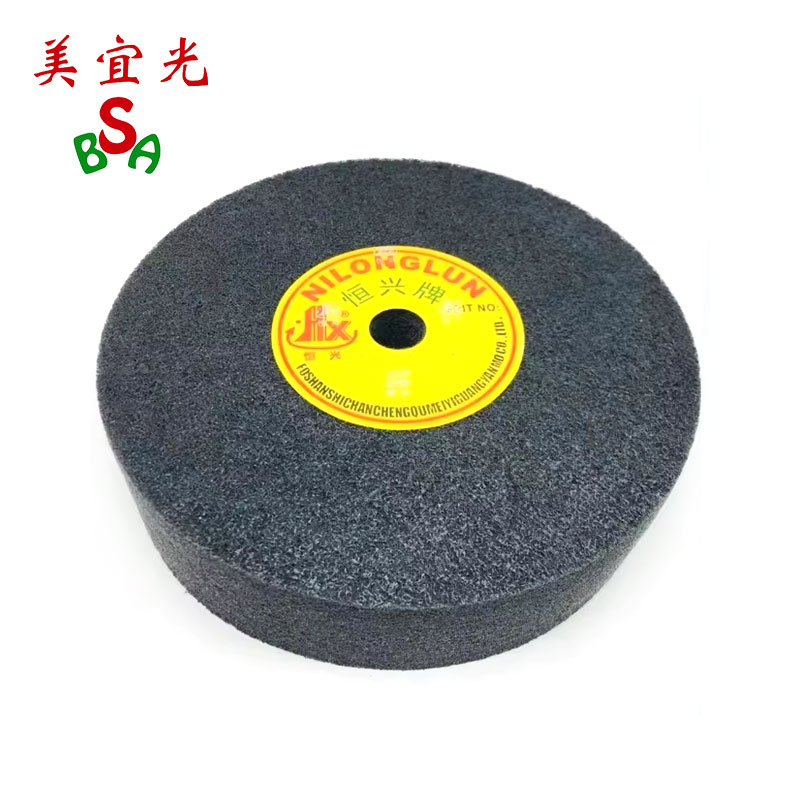
Mastering Stainless steel polishing requires strict contamination control. A single mistake ruins the final product.
You must exclusively use INOX-rated consumables on stainless steel. Manufacturers explicitly design these wheels for sensitive alloys. They manufacture them to contain less than 0.1% iron, sulfur, and chlorine. Failing to observe this rule guarantees cross-contamination. Standard wheels embed microscopic iron particles into the stainless surface. Moisture later reacts with these particles. This causes destructive oxidation and severe rust spots.
Heat presents the greatest threat during metal finishing. Excessive heat turns the steel blue or brown. We call this heat tinting. It occurs when the abrasive glazes over. The nylon web melts slightly, trapping dull abrasive grains. Friction increases exponentially. To prevent this, evaluate products containing specialized topcoats. Many modern resins actively dissipate heat. They act as cooling agents during heavy grinding.
Implement strict shop-floor rules immediately. Never share grinding tools across different metals. If an operator uses a wheel on carbon steel, it becomes contaminated. Using that same tool on stainless steel transfers carbon particles directly. Color-code your tools. Assign specific storage bins to guarantee separation.
Even premium abrasives fail if operators use them incorrectly. Avoid these four common shop-floor mistakes.
Hardware store tools cannot support industrial production. Retail brands suffer from rapid shedding. They generate high vibration levels. This vibration fatigues the operator quickly. It also leaves an inconsistent chatter mark on the metal. Commercial settings demand industrial-grade stability. Cheap tools increase your rejection rates significantly.
Operators instinctively lean their body weight into the grinder. This aggressive "pushing" motion causes instant heat buildup. It crushes the non-woven web. The wheel destroys itself rapidly. Operators should adopt a "pulling" motion instead. Drag the tool backward across the weld. Apply consistent, moderate pressure. Let the abrasive grain do the actual cutting.
Patience remains vital during surface finishing. Jumping directly from a coarse grinding disc to a fine polishing tool fails every time. The fine abrasive cannot remove deep gouges. It merely polishes the deep micro-scratches, leaving them highly visible. Emphasize a structured progression. Start with a coarse resin fiber disc. Move to a medium flap wheel. Finish with your fine unitized product.
High speed destroys non-woven materials. Standard angle grinders run at 11,000 RPM. Running these wheels at full speed melts the nylon web instantly. The melted plastic smears directly onto your workpiece. You must forcefully scrape this plastic off later. Variable speed grinders are highly recommended. Dial the speed down to 3,000 or 4,000 RPM for optimal results.
Guesswork leads to inconsistent aesthetic results. You must standardize your shop inventory based on hard data. Create a logical shortlisting process to find the perfect fit.
Never buy bulk inventory without testing. Advise your purchasing team to request specific samples. Ask your supplier for two different densities. Request variations in abrasive minerals. Test them side-by-side. Use identical scrap pieces of your actual daily material. Time the operators. Measure how fast each wheel drops a standard weld. Inspect the final scratch pattern under bright lighting.
Encourage your production managers to audit the current finishing line. Identify clear bottlenecks. Look for areas where operators spend excessive time removing heat tint. Document every step currently taken to achieve a mirror finish. Once you map the process, consult an abrasive specialist. They will help you map out a streamlined sequence. You can often reduce a five-step process down to three steps.
Choosing the perfect abrasive tool transforms your fabrication process entirely. It eliminates costly rework. It prevents catastrophic rust issues in the field. You must match the right density to the specific task. Demand premium ceramic or Silicon Carbide minerals for cooler cuts. Above all, strictly adhere to INOX contamination standards.
Stop wasting labor hours on inefficient grinding methods. Audit your current consumable inventory today. Map out your exact finishing sequence. Reach out to a technical sales team for a custom process audit. Review an industrial product matrix to find the exact size, density, and mineral required for your specific angle grinders.
A: Construction method creates the difference. Manufacturers layer and compress unitized materials, making them ideal for smaller portable tools. They wrap convolute materials around a central core. Convolute designs strictly suit larger, stationary bench grinders.
A: Excessive heat buildup causes this bluing. Too much operator pressure generates severe friction. Glazing of cheap abrasive minerals traps heat. Running the tool at too high an RPM also scorches the metal surface.
A: INOX indicates the tool is manufactured completely free of iron, sulfur, and chlorine. This chemical purity makes it totally safe for stainless steel. It prevents cross-contamination and secondary rust formation.
A: Generally, you run these wheels completely dry. Manufacturers pre-impregnate them with abrasive grain. Traditional polishing compounds are strictly reserved for soft cotton buffing wheels during the final mirror-finish stage.


