

Views: 0 Author: Site Editor Publish Time: 2026-09-10 Origin: Site


Transitioning from manual to automated finishing lines demands reliable equipment and robust abrasives. You need tools capable of withstanding continuous operation without sacrificing consistency. Unfortunately, traditional coated abrasives often struggle under the constant pressure of an automatic sanding machine. They can wear out prematurely or inflict deep, unwanted scratches on workpieces. This inconsistency ultimately leads to high rejection rates and costly rework in high-volume production setups.
Non-woven nylon sanding belts solve these exact issues. They feature a highly conformable, three-dimensional structure. This unique construction proves ideal for blending, deburring, and achieving a flawless surface finish. However, success depends entirely on proper setup. You must match these belts correctly to your specific machine parameters. In this comprehensive guide, we will explore how to integrate a nylon sanding belt for automatic polishing machine into your workflow to maximize both performance and longevity.
Nylon belts excel in delivering a uniform surface finish but require precise tension and speed control to prevent heat buildup.
Selecting the right belt relies on evaluating web density, grit equivalence, and backing strength against your specific metal or substrate.
High efficiency abrasive belt performance is heavily dependent on matching the Surface Feet Per Minute (SFPM) capabilities of your automatic polishing machine.
Implementing a standardized trial protocol is the most reliable way to measure Total Cost of Ownership (TCO) before mass procurement.
High-volume production environments face a persistent challenge. Operators frequently battle high rejection rates and excessive rework. These issues usually stem from inconsistent finishes. When traditional cloth belts degrade, their cutting profile changes drastically. The first part sanded looks entirely different from the fiftieth part. This variation forces businesses to invest heavily in secondary quality control checks.
Nylon belts introduce a massive three-dimensional advantage. Manufacturers construct these belts from an open-web network of synthetic fibers. Abrasive grains are evenly dispersed throughout this entire structure. As the nylon material slowly wears away, it continually exposes fresh, sharp abrasive grain. This continuous renewal prevents the "glazing" commonly seen in standard coated belts. Your production line maintains a consistent cut rate from the first workpiece to the last.
You must understand the different outcomes expected during machine polishing operations. Traditional ceramics and zirconia excel at aggressive stock removal. They chew through heavy welds and deep gouges quickly. Nylon dominates a different arena: surface conditioning. It blends existing scratch patterns, removes minor burrs, and prepares the metal for final plating or coating. Nylon acts as a bridge. It connects heavy material removal stages to the final cosmetic polish.
The transition yields a strong return on investment. You will immediately notice a sharp reduction in secondary processing steps. Parts often emerge from the automated line ready for final assembly. Furthermore, you decrease machine downtime significantly. Operators spend less time swapping out degraded belts and more time running parts.
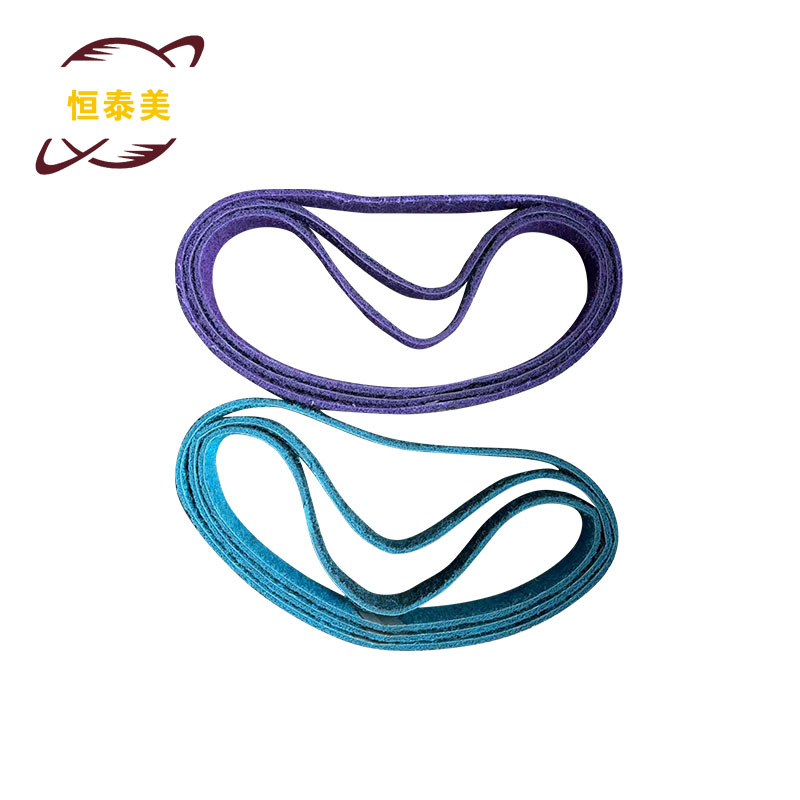
Selecting the right abrasive requires careful evaluation of multiple structural dimensions. You cannot simply grab the first belt off the shelf. Different substrates demand different configurations.
Manufacturers offer nylon belts in various densities. You must choose based on the geometry of your workpiece. Low-density webs are highly conformable. They flex easily around contoured parts, complex curves, and irregular geometries. Use low density for light blending and decorative finishing. High-density webs feel much stiffer. They deliver a far more aggressive cut. Choose high-density belts for flat surfaces, straight edges, and heavy deburring tasks.
The mineral embedded inside the nylon web dictates cutting efficiency. Aluminum oxide serves as the industry standard. It is tough, blocky, and fractures well under pressure. Aluminum oxide works optimally for carbon steel, bronze, and general-purpose finishing. Silicon carbide offers a different profile. It is sharper and more brittle. This grain penetrates hard surfaces easily. Silicon carbide proves superior for titanium, stainless steel, and achieving a bright, scratch-free polish.
Non-woven abrasives do not use the standard FEPA or CAMI grit grading scales. They rely on their own specific terminology. You must understand this conversion to select a durable sanding belt appropriately.
Nylon Grade | Abrasive Mineral | Approximate FEPA Equivalent | Primary Application |
|---|---|---|---|
Coarse (CRS) | Aluminum Oxide | P80 - P120 | Heavy deburring, removing heavy rust |
Medium (MED) | Aluminum Oxide / Silicon Carbide | P150 - P180 | Blending scratch patterns, edge radiusing |
Fine (FIN) | Aluminum Oxide | P240 - P320 | Pre-plating preparation, light cleaning |
Very Fine (VFN) | Silicon Carbide | P320 - P400+ | Final cosmetic finishing, satin brushing |
A nylon belt is only as strong as its foundation. Industrial belts feature a reinforced scrim or woven backing. Assess the tensile strength of this scrim carefully. A weak backing leads to catastrophic failure. Furthermore, inspect the splice integrity. The joint must withstand the immense tension of automated industrial equipment. A poorly manufactured splice will instantly snap, halting your production line and potentially damaging your machinery.
Even the highest quality belt will fail if paired poorly with your equipment. You must calibrate your machinery to match the unique characteristics of non-woven nylon.
Nylon fibers generate significantly more friction than standard cloth belts. Running a nylon belt too fast causes massive problems. You risk smearing the workpiece or completely melting the synthetic fibers. Always adhere to optimal speed ranges. Most manufacturers recommend operating non-woven belts between 2,500 and 4,500 Surface Feet Per Minute (SFPM). Lower speeds reduce heat generation and prolong belt life.
Your contact wheel dictates how the belt interacts with the metal. Wheel hardness is measured in durometers. Hard durometer wheels (70-90 Shore A) force the abrasive aggressively into the workpiece. They allow for faster feed rates and heavier deburring. Soft durometer wheels (30-50 Shore A) act like a cushion. They provide better blending capabilities. Soft wheels drastically lower the risk of gouging the substrate, ensuring a uniform surface finish.
Nylon stretches very differently than traditional polyester or cotton backings. It has an inherent elasticity. You cannot rely on static tensioning mechanisms. Highlight the need for pneumatic tensioning systems on your machinery. Pneumatic cylinders automatically compensate for belt stretch during operation. They maintain constant, even pressure across the contact area. This consistency is strictly required for flawless automated finishing.
Consider introducing fluids to your process. While many operators run nylon dry, coolants offer major advantages. Wet applications extend belt life drastically. Coolants absorb generated heat, preventing the nylon from reaching its thermal breakdown point. Additionally, fluids flush away metal swarf. This flushing action keeps the abrasive web clean and aggressive.
Deploying non-woven belts on automated lines introduces specific operational hazards. You must anticipate these challenges and apply proven mitigation strategies to protect your investment.
Risk 1: Thermal Damage (Overheating)
Nylon fibers melt if pushed past their thermal threshold. Smearing ruined parts and destroyed belts are common outcomes. Mitigation: Reduce your feed pressure immediately. Optimize your machine RPMs to stay within the recommended SFPM range. If problems persist, introduce mist coolants to dissipate heat away from the contact zone.
Risk 2: Tracking Instability
The natural elasticity of nylon can cause belts to wander off the contact wheel. This wandering leads to uneven wear and potential safety hazards. Mitigation: Perform regular calibration of optical or pneumatic tracking sensors on your equipment. Ensure all idler wheels are perfectly aligned and free of debris.
Risk 3: Loading on Soft Metals
Aluminum, brass, and copper generate sticky swarf. This soft metal debris can quickly clog the open web, neutralizing the abrasive grains. Mitigation: Switch to open-coat variations designed specifically for non-ferrous metals. Alternatively, apply specialized grease sticks or dry lubricants to the belt before operation to prevent adhesion.
Purchasing abrasives for large-scale operations requires a methodical approach. You cannot rely on guesswork when outfitting automated machinery.
Start by defining your primary objective. What is the ultimate goal for the part? If the priority is aggressive deburring, you need high-density, coarse-grade belts. If you require cosmetic finishing, shift your focus toward very fine silicon carbide options. Pre-plating preparation usually demands a medium-grade aluminum oxide to leave a consistent, easily coated anchor pattern.
Not all suppliers maintain the same quality standards. Look for abrasive manufacturers who provide clear, comprehensive data. They should willingly supply documentation on splice types, maximum RPM ratings, and abrasive grain concentrations. Avoid vendors who obscure their technical specifications. Transparency indicates a reliable, industrial-grade product.
Never overhaul your entire inventory based on a brochure. Implement a strict, standardized trial protocol on your shop floor.
Run a baseline test using your current coated abrasives. Document the exact time required per part and the total number of parts finished per belt.
Introduce the high efficiency abrasive belt under identical operational variables. Do not change feed rates or wheel pressure yet.
Evaluate the financial impact properly. Measure the exact cost-per-finished-part rather than focusing solely on the upfront cost-per-belt. A more expensive nylon belt often yields a lower cost-per-part due to extended lifespan and fewer rework cycles.
Nylon sanding belts successfully bridge the critical gap between heavy stock removal and final cosmetic polishing. They offer unmatched consistency for automated manufacturing lines. Their unique three-dimensional web guarantees a fresh cut and a repeatable finish, significantly reducing costly rejection rates.
However, we must note a skeptical reality. These belts are not magical cure-alls. Their success is entirely dependent on proper machine calibration. You must manage heat effectively, control tension pneumatically, and respect optimal operating speeds. Ignoring these parameters guarantees premature belt failure.
Take action today. Advise your engineering team to request sample belts from reputable manufacturers. Run a localized pilot test on a single automated cell. Gather hard data on your specific substrates before committing to a massive abrasive inventory overhaul.
A: Traditional coated belts feature a single layer of abrasive grain glued to a flat backing. They are designed for aggressive material removal and heavy grinding. Non-woven nylon belts consist of a three-dimensional synthetic web with grains embedded throughout. They focus on surface conditioning, blending scratch patterns, and delivering consistent finishes without altering part geometry.
A: Not always. Nylon stretches more than cloth or paper backings. Your machine needs robust pneumatic tensioning capabilities to handle this elasticity. Additionally, you need variable speed drives. Nylon requires lower operational speeds to prevent friction-induced melting, so fixed high-speed machines may cause thermal damage.
A: First, ensure you mount the belt in the correct rotational direction if directional arrows are present. Second, never exceed the maximum tension limits of your machinery. Excessive static tension rips the splice apart. Finally, source belts with high-strength reinforced scrim backings designed specifically for industrial automated equipment.
A: Lifespan varies entirely based on application variables like feed pressure, metal type, and coolant usage. While they may cost more upfront, nylon belts often outlast traditional cloth belts in finishing applications because they do not glaze over as quickly. Measure success by overall cost efficiency per finished part rather than exact running hours.


