

Views: 0 Author: Site Editor Publish Time: 2026-09-18 Origin: Site


Surface preparation often hides significant operational expenses. Operator downtime eats into shop profits daily. Frequent belt replacements waste valuable time. Inconsistent finishes frequently cause costly rework. Fabrication shops face a major transition today. They are moving away from traditional coated abrasives. Instead, they choose non-woven surface conditioning belts. You need to understand this vital shift.
We will compare nylon and sandpaper belts directly. Buyers can then match the right abrasive to their specific needs. You will learn the technical differences between these tools. We also explore their financial impacts on daily operations. This guide provides a clear breakdown of durability, efficiency, and finish quality. You can use these insights to optimize your grinding workflow and reduce waste.
Primary Application: Sandpaper belts excel at aggressive stock removal and shaping; nylon sanding belts are engineered for surface conditioning, blending, and polishing.
Longevity: Nylon’s 3D open-web structure resists loading (clogging), generally providing a long service life compared to an ordinary sand belt when working on softer metals like aluminum.
Finish Consistency: Nylon belts deliver a highly uniform grinding effect without altering the workpiece's underlying geometry.
Cost Efficiency: While nylon belts often carry a higher upfront price, they act as a cost-saving abrasive belt in the final finishing stages by eliminating multi-step sanding processes and reducing changeout frequency.
You must understand how these tools are built. Their structures dictate their performance on the shop floor. Each belt utilizes entirely different manufacturing principles.
An ordinary sand belt relies on a traditional coated structure. It features three primary layers. First, a backing material provides the foundation. Manufacturers typically use heavy cloth or stiff paper. Next, a strong bonding resin coats this backing. Finally, abrasive grains sit rigidly within the resin layer. Common grains include aluminum oxide, zirconia, and ceramic.
The mechanism focuses on aggressive material removal. These belts cut deep and fast. The fixed grain structure shears off material upon contact. However, this rigid design has limitations. The belt degrades as the grains dull from friction. The surface also loads up quickly when sanding softer metals. Dust and debris pack between the grains. This stops the belt from cutting effectively.
Non-woven belts use a fundamentally different architecture. They feature a three-dimensional web. Synthetic nylon fibers intertwine to create this porous structure. Manufacturers infuse these fibers evenly. They embed abrasive grains and resin throughout the entire web.
The mechanism acts like a dense, resilient cushion. It compresses slightly upon contact. The nylon fibers slowly wear away during use. This continuous wear exposes fresh abrasive grains underneath. You maintain a highly consistent cut rate. The cushioning effect also prevents accidental gouging. Operators can blend surfaces smoothly without digging into the base material.
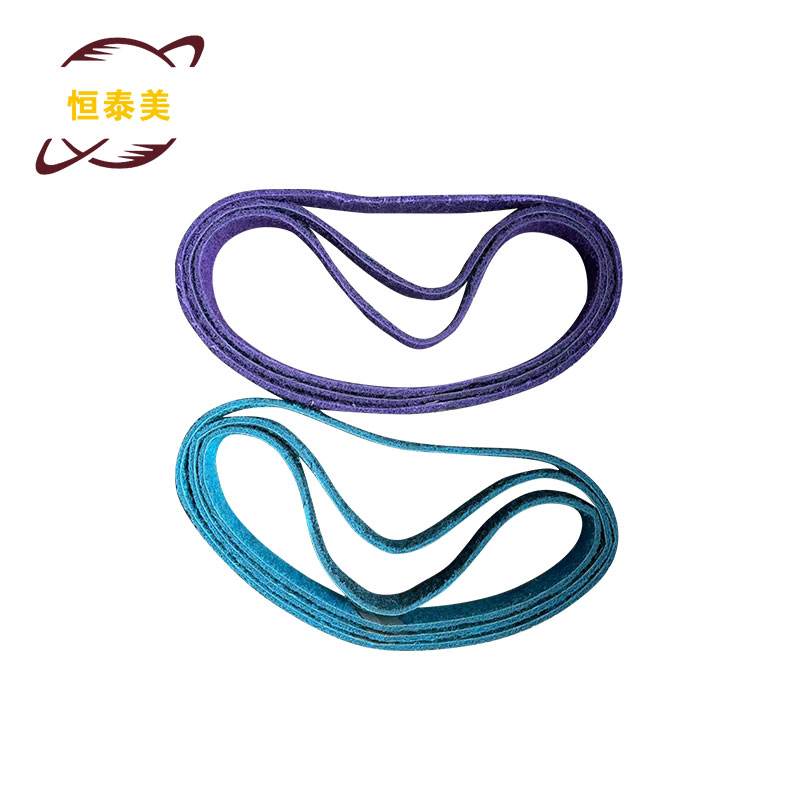
Choosing between a nylon sanding belt vs sandpaper belt requires careful evaluation. They behave differently under heat and pressure. Their material removal rates vary significantly.
Heat generation destroys abrasives quickly. It ruins sensitive workpieces. Sandpaper belts frequently retain excess heat. The dense backing traps thermal energy during continuous grinding. This leads to premature abrasive wear. It also warps thin metals like stainless steel panels or automotive bumpers. Heat discoloration requires extra finishing steps to fix.
Nylon belts excel at heat dissipation. Their open-web design promotes constant airflow. Air circulates through the nylon fibers while spinning. The belt runs noticeably cooler. This prevents the abrasive from glazing over. It protects sensitive metals from warping. Superior thermal management directly contributes to a long service life.
Material removal capabilities define each tool's primary purpose. Sandpaper wins outright for heavy dimensioning tasks. You need coated abrasives for leveling structural welds. They easily remove heavy mill scale from raw steel. They excel at initial shaping tasks.
Nylon belts serve a different purpose entirely. They do not alter part dimensions. Instead, they provide high efficiency sanding for surface correction. They rapidly remove minor surface defects. They strip rust or severe oxidation in one clean pass. The efficiency lies in surface refinement. They clean the metal without damaging the underlying base material.
You must evaluate the resulting scratch pattern. Sandpaper leaves a distinct, linear scratch. The fixed grains dig deeply into the surface. Operators must use progressive grit stepping. They start coarse and slowly move to finer grits. This multi-step process removes the previous deep scratches.
Nylon conforms beautifully to irregular surfaces. The compressible fibers adapt to curves and contours. This flexibility delivers a predictable, uniform grinding effect. Nylon perfectly creates brushed finishes on aluminum or stainless steel. It preps natural stone seamlessly for final polishing. You get consistent results every single time.
Different industries require specific abrasive combinations. Let us look at real-world applications. We can match the right tool to specific materials.
Fabrication shops constantly tackle tough challenges. Operators must remove structural TIG welds. They also need to match precise cosmetic finishes, like a #4 brushed stainless finish.
The decision logic is simple. Use coarse ceramic sandpaper belts first. They flatten the weld seam aggressively. Then, switch immediately to a medium-grade nylon belt. The nylon blends the surrounding area flawlessly. It matches the factory grain direction. Aluminum requires special care. It clogs ordinary belts quickly. Nylon resists this loading entirely.
Restoration shops handle delicate, irreplaceable parts. Operators strip old paint from vintage car panels. They remove deep rust from classic chrome bumpers. The underlying metal is often very thin. You cannot afford to remove base material.
Nylon belts are vastly superior here. They strip paint and rust safely. The non-loading properties keep the belt cutting smoothly. Their forgiving nature hugs the complex contours of car panels. You avoid grinding flat spots into curved bumpers.
Woodworkers and stone fabricators follow strict progression rules. Wood requires rapid leveling to achieve flat dimensions. Stone requires a delicate sheen preparation before the final chemical polish.
Sandpaper remains the absolute standard for wood dimensioning. Nylon does not level wood effectively. However, nylon adapts well for final scuffing. It conditions stone surfaces beautifully. It creates the required micro-scratch finish before final buffing.
Chart: Abrasive Application and Performance Comparison
Application Scenario | Sandpaper Belt Capability | Nylon Belt Capability |
|---|---|---|
Heavy Weld Removal | Excellent (Fast dimensioning) | Poor (Not designed for stock removal) |
Surface Blending | Fair (Leaves linear scratches) | Excellent (Seamless integration) |
Rust & Paint Stripping | Fair (Clogs quickly, removes base metal) | Excellent (Resists loading, preserves base) |
Curved Contours | Poor (High risk of gouging) | Excellent (Cushions and conforms) |
Purchasing decisions require a close look at financial returns. You must analyze upfront prices versus daily operational spending. Initial costs only tell part of the story.
High-quality nylon belts cost more per unit. Buyers often hesitate at this initial price tag. Coated paper belts appear cheaper on the purchase order. However, cheap belts fail quickly. Constant replacements drive up daily operational spend. You consume dozens of paper belts to achieve one perfect finish.
You unlock massive savings by reducing hidden workflow inefficiencies. Let us break down the exact operational benefits:
Labor Cost Reduction: Operators spend less time changing torn belts. Continuous production increases daily output.
Scrap Reduction: Sandpaper easily gouges expensive parts. Accidental over-grinding ruins raw materials. Nylon prevents these costly mistakes entirely.
Process Consolidation: Operators skip multiple grit steps. You can jump straight from a 120-grit sandpaper directly to a medium nylon belt. This eliminates intermediate sanding phases.
Smart shop managers view surface conditioning tools strategically. We frame the nylon belt as a cost-saving abrasive belt. You must utilize it specifically in secondary blending stages. Do not use it as a total replacement for coarse shaping tools. Proper integration reduces labor hours and perfects the final product.
Transitioning to new abrasive systems carries some operational risks. You must evaluate your current equipment carefully. Quality control is crucial when buying new inventory.
You must ensure your shop's machinery is compatible. Belt sanders, orbital sanders, pipe polishers, and stationary grinders need variable speed control. Nylon belts require specific operating parameters. They often demand lower RPMs than coated abrasives. High speeds generate excess friction. This friction can literally melt the synthetic nylon fibers onto the workpiece. Variable speed dials solve this problem easily.
The market is flooded with low-tier products. You must warn your procurement team about cheap nylon belts. Inferior belts fray rapidly at the seams. They shed nylon fibers under moderate pressure. This leaves messy residue on the metal. Premium belts feature reinforced backings and high-quality resin binders.
We recommend auditing your current sanding workflow immediately. Observe your operators on the floor. Identify the exact bottlenecks. If the bottleneck is "removing material too slowly," buy ceramic or zirconia sandpaper. If the bottleneck is "spending hours achieving a final finish," act now. Shortlist premium non-woven nylon belts for immediate testing.
The choice between these two abrasives is not an either/or scenario. They serve as complementary tools within a professional abrasive system. You need both to maximize shop efficiency.
Use coated sandpaper for altering geometry and removing heavy stock. It gets the rough work done fast. Then, integrate nylon belts into your workflow. They perfect the surface finish smoothly. They reduce heat buildup on sensitive metals. They streamline the final polishing steps.
Take action on your production floor today. Prompt your procurement teams or shop managers to request a sample pack. Consult directly with an abrasive specialist. Test the non-woven belts on your specific materials to see the immediate operational improvements.
A: Yes, coarse-grade nylon belts can remove surface rust effectively without altering the metal's thickness. However, heavy mill scale is better suited for a ceramic sandpaper belt. Ceramic grains fracture cleanly to strip thick scale faster.
A: Edge-fraying typically occurs from excessive pressure. You must let the abrasive do the work natively. It also happens when using the belt on sharp, burred edges. These sharp burrs easily tear the non-woven synthetic web.
A: Yes. Nylon belts generally perform best at lower speeds. A reduced RPM prevents excessive heat buildup. High heat can easily melt the nylon fibers. Melted nylon will smear across your workpiece and ruin the finish.
A: Nylon belts do not use standard FEPA or CAMI grit numbers. Manufacturers typically categorize them by texture. Coarse equals approximately 80 to 120 grit. Medium covers 120 to 180 grit. Fine mimics 320 grit. Very Fine reaches 400 grit and above.


